Turning code into riches
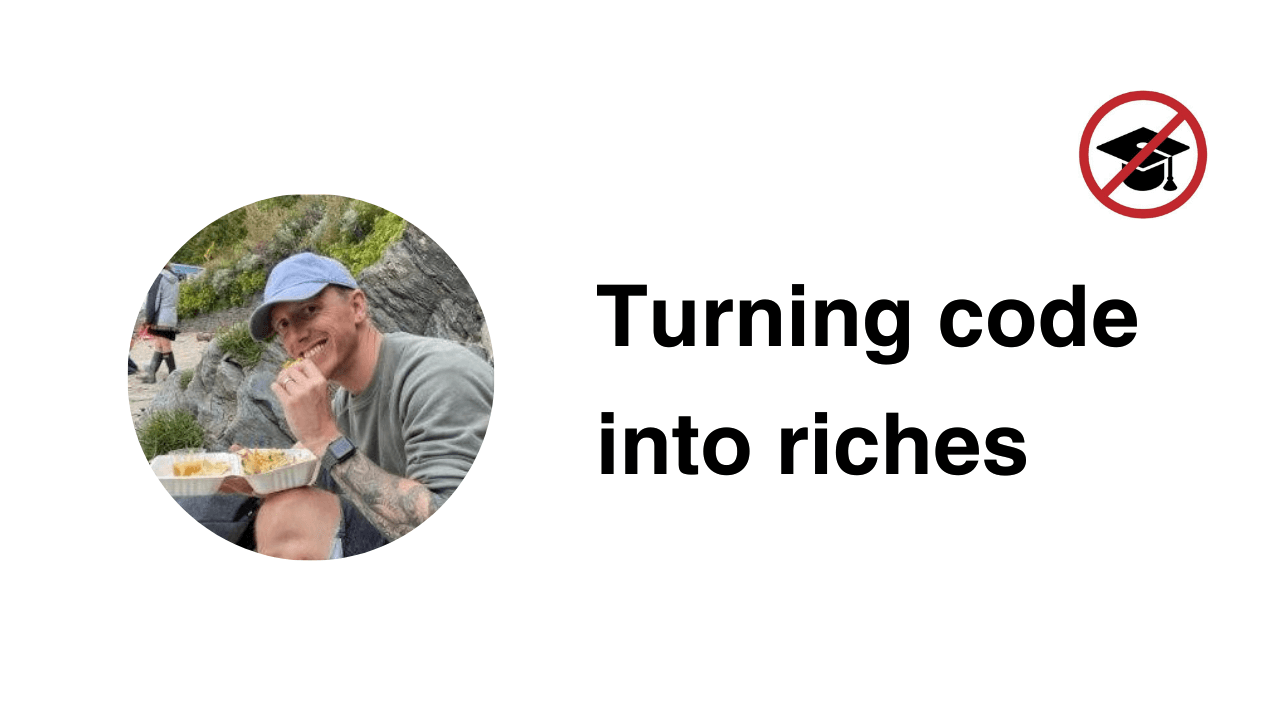
Ian Nuttall has used the powerful combination of coding knowledge and marketing skills to produce several impressive exits. He sold an education company for 7 figures and has a string of successes from tapping into SEO opportunities. Ian is a self-taught developer and he’s going to tell you how to use AI to get ahead of the competition in 2025!
Can you give a quick intro?
I’m Ian Nuttall, and I’ve been building internet businesses for almost 20 years. I live in Nottingham in the UK, and I’ve worked from home for the last decade.
I’m currently working on a content marketing automation tool and my programmatic SEO course, as well as a handful of programmatic SEO sites that make me passive income (albeit at the whims of Google and their algorithm!).
Can you tell us what you’ve achieved so far as a founder?
I’ve built so many things over the years! For the sake of brevity I’ll give you the highlights:
- A $30k+ MRR education startup (acquired for multiple 7-figures). This was a membership community for teachers to download teaching resources.
- The most comprehensive programmatic SEO course on the web with 1500+ customers. I current merged my AI coding course into this and plan to do a lot more content next year. The course has made over $200,000 in revenue since I launched a few years ago.
- Cuppa - the AI content writer that pretty much everyone uses now!
- A no-code programmatic SEO tool to scale content for SaaS businesses. This is the content marketing tool I’ve been working on with my co-founder. We’re very close to $1k MRR and hoping to do a big push next year.
- Launched Keyword Metrics, an SEO tool to find keywords you rank for but could rank better for. This was recently acquired
- Launched URL Monitor, an SEO tool to get your pages indexed in Google. The app scaled to $8k MRR pretty quickly before being acquired for $250k.
- Created a library of video lessons on how to code using AI. These have now been merged into my pSEO course.
- Many, many (seriously MANY) programmatic SEO sites (the biggest was acquired for $500k)

How did you first learn to code?
I first learned to code after I acquired a WordPress site called OpenDesigns.org. It was a free library of open source HTML and CSS templates, powered by a custom plugin.
I had to figure out how to fix PHP errors in upgrading to the latest WP and then make changes to the plugin to add the features I wanted to the tool. This was back in 2006 before Stack Overflow and it was a real trial and error process.
I also built a UK tax calculator and ported that across many different languages, from PHP to JavaScript to an iOS app at one point as well!
If I could go back I probably would have taken some kind of fundamentals course earlier to really focus on the basics, but trial and error STILL works well for me all these years later!
How should entrepreneurs start to learn to code?
The quicker you can get to writing code on a project for yourself, the better. There are plenty of free courses to learn about variables, loops, classes, etc. Once you have a good enough broad understanding, fire up an AI powered editor like Cursor, Windsurf, or the Cline VS Code extension and start building.
Learning to code alongside AI is going to be the way most entrepreneurs start learning to code and being able to see results very quickly. I have a friend who is churning out micro SaaS products daily and he has never coded before in his life.
How are using AI to learn more?
I tend to switch between Cursor and Windsurf editors right now and pretty much exclusively use Claude Sonnet. Recently it feels like Anthropic reduced the quality, though.
The more context the AI has, the better it is, so I have been really focusing on taking the time to do that. For example: I’m building a bunch of free SEO tools right now and I created a document that outlines very specifically how each one of them is built, how they are designed, and whether they need a scraper, a Cloudflare capture, etc.
I can now pass that document to Cursor and say “build me a new AI tool that shows me the top 100 backlinks for a URL” and it will know which API provider to use and produces a very good v1, pretty much every time.
Then I can chat back and forth to finalise it before launching the tool. Using Laravel has really helped because pretty much everything you need is already built into it. I don’t need to use third party tools for a lot of the basics like I would with Next.js.
How did you make your first money online?
I built a lot of niche sites on various topics to make money from Google AdSense. They started off as pure content sites and writing articles but I don’t like to do boring and repetitive tasks, so I started looking at ways to improve that and remove the bottle neck.
The first way was to build tools instead of writing content. My UK tax calculator is a great example of that. I got weirdly obsessed with having the most accurate calculation on the market while keeping it very simple to use.
Then I noticed that people were searched on Google for “{£salary} after tax” for pretty much every salary amount you could think of.
This is where I first discovered programmatic SEO. I was able to use the calculator code I had built and pass it the value from the URL to calculate the salary after tax for any number between 1 and 1,000,000.
What is programmatic SEO and how did you use it to make money?
Programmatic SEO used to just be called “dynamic pages”. You have a template which has placeholders for your variables, and you have a data source that injects the values into the template at scale - sometimes millions of pages.
Think about the Airbnb pages like “Holiday rentals with a pool in Thailand”. All of their content is populated by their database. If another rental is added, the content of the page will change to include it.
You can use this to target a lot of long-tail keywords or variations of keywords at scale and become a topic authority on a subject.
Since I’m not at the level of Airbnb, I make sure my template are much more robust. I have conditional content based on the data, so if the temperature in a location is high, I might have a warning to wear sunscreen one day, but not another.
I also include charts, tables, images, and other elements than can change depending on the data and when it gets updated.
How did you sell a site for $500k?
I bought a website about fractions. Yes, math fractions. The site is VisualFractions.com and I bought it for $2,000.
Using all of the techniques I learned from building the salary after tax tool, I did the same thing for a lot of fraction and math equations.
The site was used by students and teachers in schools across the world, so I made sure to not only solve the problems but provide step-by-step explanations of how it was solved. The goal was to help students learn the process so it could be applied to any problem they had.
I eventually sold this via FE International along with another site I had for generating custom worksheets for students. Basically you select a few values from a form and it would create unique and random printable worksheets.
The sale process was long and slow and a lot of due diligence, but FEI handle almost all of the seller communication which made it a bit easier for me.
You sold URL Monitor for $250k - how did that happen?
Well when you start building sites with thousands or millions of pages, you come across a problem. The more pages indexed, the more chance you have of getting traffic to them and making money from ad clicks or product sales.
This got me looking at the most effective ways to index a lot of pages at scale. I originally built myself a janky little Python script to do this for my own sites and it worked incredibly well.
People started to ask me how they could do it too, so I rebuilt it in Laravel using AI. This was before Cursor so I was manually copy/pasting back and forth from Claude/ChatGPT to my app!
It scaled really quickly and became a technical challenge because of the volume of pages I was processing daily. I had to get creative with it to get around some of Google’s invisible rate limits!
I sold it because I was a little worried about the rise in awareness of indexing tools and the Google API not being built for that. John Mueller from Google had already mentioned it and I thought they might kill it. (and they did!)
The sale process was easy because it was acquired by Chris Riley, who had already acquired the AI writer Cuppa from me. He acquires a lot of my stuff!
Where can people find out more about you?
For AI coding stuff I have some free videos on my YouTube channel: https://www.youtube.com/@inuttall
For programmatic SEO I have my course and my software:
https://practicalprogrammatic.com/
You can also follow me on the socials:
https://www.linkedin.com/in/iannuttall/
https://bsky.app/profile/ian.is
I also have an email list but I very rarely email (which people seem to like/look forward to them!):