Learning to code after his friend made 4x more
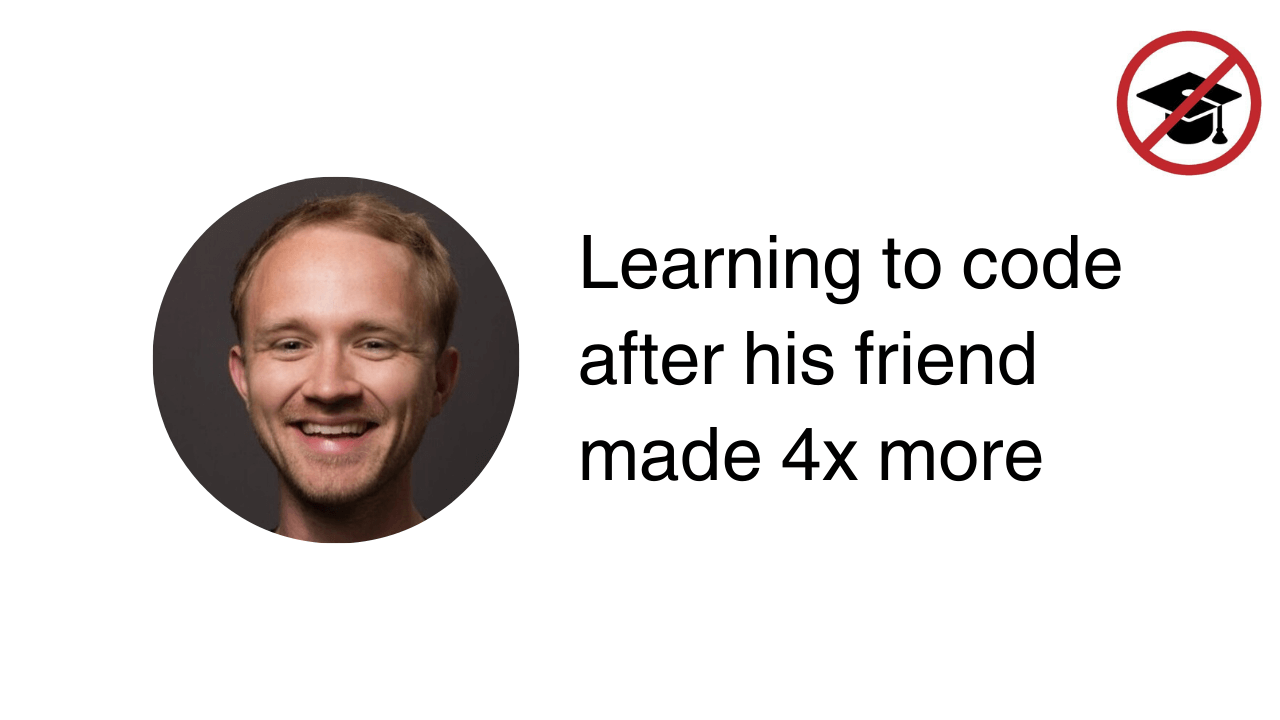
Matthias was earning a low wage at a cinema with his friend. Then he saw his friend make 4x more by learning to code! So Matthias learned as well and became a Full-Stack Developer. He is now working on a side project, SaaSFYI, alongside his full-time job. You can read his interview below.
Code faster with Claude!
I’ve used Claude to make Chrome extensions, financial calculators and improvements to my websites. Last night I showed someone at a hackathon in Edinburgh how to make their personal website with Claude. And I’m just scratching the surface of what’s possible.
So I’m going to make a course for coding with Claude.
Interested?
I want to make something valuable for you so I’d love it if you complete this 30-second survey
Hey, so can you introduce yourself?
I’m Matthias, currently working as a Full-Stack Developer in Munich, Germany. I’ve worked as a developer for the past five years. I originally started my career by bootstrapping a company with a friend for about two years, which we eventually shut down. Afterwards, I freelanced for a while before looking for something more stable and landing a full-time role.
The company I work for has around 1,000 employees, and I’m part of their innovation team, where we identify new product ideas, build prototypes, and test them with early users. My team is distributed across Germany, and I work fully remotely. It’s actually a really cool job. My main tech stack is Python for backend development (mostly FastAPI these days; I used Django extensively before), some JavaScript for frontend work (mostly React, depending on the project), and a lot of cloud infrastructure on AWS.
Why did you learn to code?
Originally, a friend of mine who also didn’t study CS started coding a video game by himself as a side project, simply because he wanted to. He didn’t know any code before starting, but after a few months he had a really cool video game we could play. That was incredibly inspiring. What’s more, with the coding experience he gained during those few months (around 3–6 months), he randomly landed a freelance gig as a VR developer that paid a lot at the time. We used to work at a cinema together, earning about €13 per hour, and all of a sudden he was making €50–60 per hour.
Watching him do all that, I thought to myself: if he can do it, why shouldn’t I? At the time, I was practicing a lot of meditation using visualization techniques, and I had an idea for an app to support this type of meditation. So I started writing some C# in Unity (tbh the worst choice for starting to learn coding, but oh well). I told myself that if I could build this idea in about three months, that would already be a huge success. After just 2–4 weeks, I had a working app, and that really gave me the confidence that I could build whatever I wanted.

How did you learn coding?
As described before, I started with C# in Unity3D and just googled anything I needed to know, watching a ton of YouTube tutorials to get through the first few steps. Looking back, this was really just the starting point. I didn’t enjoy C# or game development / VR that much. At the time, I was far more interested in data science and AI, so I started learning Python. I fell in love with it right away and never looked back.
The real learning started when I dedicated myself full-time to building a software startup with a friend. We were fortunate to receive a startup grant that helped us pay rent for a year, and that really kick-started everything.
What software projects are you working on just now?
On nights and weekends, I work on SaaSfyi.co. It’s a product for folks selling products or services to SaaS companies, helping them find leads and build outreach lists. It’s built with Django, React, and TypeScript, and deployed on Render.
I want this to become the tool you go to whenever you want to sell to SaaS companies, with the most in-depth data on a company’s hiring activity, web traffic, tech stack, employee data, and more, basically anything that helps identify companies and people worth reaching out to.
Other than that, I’m currently brainstorming some ideas with my brother, which I’m super excited about as well, but nothing is live yet. In my day job, I work on a bunch of different projects broadly in the space of domain parking and traffic arbitrage.
How did you get your first web development job?
The first time I applied for web dev jobs was after shutting down my first company. Working on that company gave me 1–2 years of experience, which was really helpful when applying for jobs. I also did some freelancing while building the company.
It helped a lot that I was building a product from scratch, because it made it easy to talk to companies using the same tech stack (Django, React, AWS, Heroku at the time) and land freelance gigs that way. Together, those two experiences, founding and freelancing, made finding my first web dev job relatively easy. I got offers both through my network and from cold applications.
The interview process differs from company to company. Smaller companies tend to have fewer rounds, usually 2–3, with at least one technical interview. Bigger companies often have 4–5 rounds, usually with around three technical interviews. For me, the technical interviews are the toughest part.
How technical interviews are run depends on the company: some use take-home assignments, while others do live coding. Depending on the role, it’s usually a mix of data structures and algorithms (DSA) and system design. For my first full-time role, I had a take-home assignment where I had to design and implement an API endpoint that translated an HTML document, followed by an hour-long call to present it and answer questions.
How has your life changed since learning to code?
Honestly, it has changed a lot. First, the ability to just build stuff that I want to build. It’s great knowing that I can open my laptop, write some code, deploy it, and potentially have millions of people use it.
Second, the ability to generate cash from that skill. Whether as a freelancer or an employee, it’s great to know that I have a skill I can sell on the market. University taught me zero such skills, lol. And even though there’s a ton of bad news coverage out there, it’s still in high demand, so I don’t feel insecure about my ability to generate income.
Third, it’s great to understand how software works. Software is eating the world, and understanding it gives you a lot of leverage.
Lastly, learning to code mostly by myself gave me the confidence that I can learn anything on my own, which is really empowering. Every now and then I think about other careers I’d like to explore, and now I know I can just start teaching myself the required skills to get going (except probably medicine or law 😄).
What does a typical day as a software developer look like for you?
As I said previously, I work fully remote, so I always work from home (I’m not into the digital nomad lifestyle and all that). My day job consists of fairly few meetings. I have some Scrum meetings (dailies, weekly meetings, reviews, retros, etc.), but they don’t eat up a lot of my time.
I usually have my daily in the morning with the entire team, where we discuss current issues, what we’ll work on during the day, and clarify any open questions. These days, I do quite a lot of pair programming with a colleague because we work together on a bunch of projects, so I’m frequently sitting in calls with them. I hadn’t done much pair programming before, but I have to say I really like it, especially in the context of remote work, because it allows me to collaborate and interact more closely with a colleague.
Task-wise, it really depends on what the highest priority is that day or week. Sometimes it’s fixing a bug or adding a feature; other days it’s updating something on the infrastructure side, or helping out a colleague or another team. Quite often, we also need to gather requirements and define scope for new projects, which usually involves some research as well.
In terms of tech stack, it’s mostly AWS, Python, and JS/TS. I recently had to write an API in Go, which was the first time I ever worked with Go in production.
What are your views on AI and how it affects coding?
AI definitely has a big impact on my day-to-day. It helps a lot with boring tasks, for example, if I know how an API endpoint should look, I can describe it to an AI, and it often does a pretty good job implementing it.
However, I think a world where we don’t need software developers anymore is still far away. AI is a great tool, but it’s far from being able to work autonomously. You still need people to review AI-generated code, and those people need to be skilled software developers.
I work a ton with AI, and while it’s really helpful, it’s still quite limited. It’s hard to describe, but if you use AI a lot and have coding experience, you know what I mean.
So, long story short: I’m really happy to have AI as a tool and I use it every day, but I’m not yet worried about it taking my job. We’d need to reach AGI for that, and I’m very skeptical that LLMs will get us there. I don’t hear about AI advancements outside the current LLM paradigm, so I don’t think this will happen anytime soon.
What are your career goals for the future?
I’m actually quite happy working full-time and would like to continue progressing there. I enjoy the stability and peace of mind it provides. That being said, I really enjoy working on side projects like SaaSfyi.co, and it would be awesome if one day a side project I started could grow into a reasonably sized business. If anyone reads this and wants to reach out, feel free to email me at matthias@saasfyi.co.
Thanks for the interview!
I hope you enjoyed this chat.
I’ll be back next Wednesday with another interview.
Thanks,
Pete
p.s. Please check out my Claude course survey