Self Taught Web DeveloperUS Software Engineers
A Self-Taught CTO Shares Tips on Learning to Code
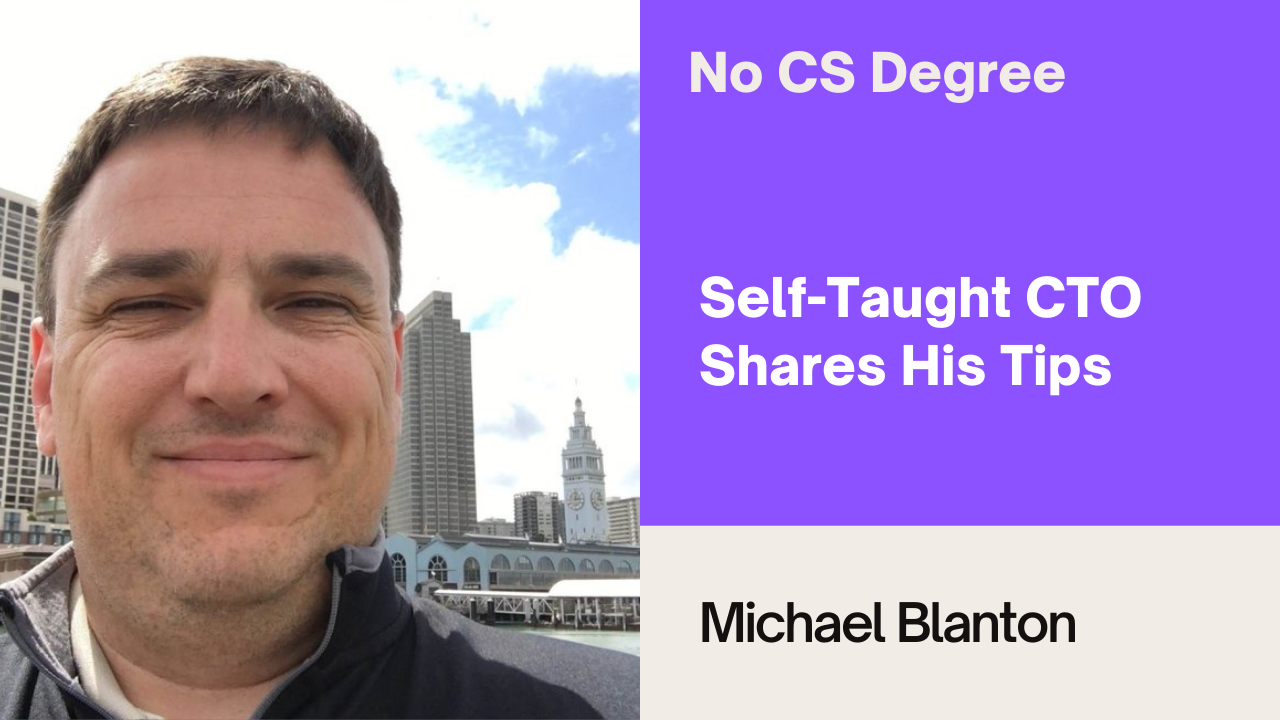
Michael Blanton is a self-taught developer and CTO. In this interview he shares tips on learning to code, getting hired and what being a software developer is really like. Enjoy!
Hey, so can you introduce yourself?
I’m Michael Blanton, Chief Technical Officer and Chief Cat Herder at Xiggit. I live in Livermore, California, about 60 miles east of San Francisco and about 40 miles north of San Jose.

Why did you learn to code?
I’ve always enjoyed computers and connecting with people through technology. I enjoy helping people solve problems. I enjoy figuring out how to make different systems talk to each other. I knew this was a career path I wanted to explore, so I started working on a CS degree in college and went from there.
How has your life changed since learning to code?
Once you learn how to code - it doesn’t matter the language - there are so many more possibilities that open up. Just about anything can be scripted or automated. Just about any program you are using has some sort of scripting or API available.
Want to analyze a bunch of data? Write a script. Want to pick a random winner for a drawing? Write a script. Want to suck a CSV file into a database? Write a script. Doing development doesn’t necessarily mean you are writing thousands of lines of code. Tasks that used to be very manual can now be fairly easily automated with a few lines of code, saving you (and your partners) hours of work.
Do you have tips for people who want to learn to code without doing a degree?
You definitely don’t need a degree to be a successful developer. I even encourage my own children to shy away from a CS degree - major in something you find interesting and related to what you want to focus on and do a CS minor to get the basics. Otherwise, find a well-reviewed online class and start there.
Don’t be afraid to dive in, and don’t be scared to ask questions. Most of the good online courses will go through building an actual functioning like (like a note-taking program). So start with that simple starting point and start slowly adding your own pieces to it. Then, once you have the basics down, find something else simple to build. No matter what you build, always break it down into small chunks so you can feel good about the progress your making.
What was the interview process like for your first developer job?
My first developer job was actually as an intern in College. It was more about personality and motivation at that stage. I didn’t really have any solid technical chops at that point. Did they think I could figure stuff out as we went along? Could I work unsupervised? Did I have enough ambition? Could I understand the requirements and communicate clearly?
My first boss had a Psychology degree from Stanford and the other developer on the team at the time didn’t have a degree at the time, either. Since then, I’ve interviewed for various positions that we’ve whiteboarded out solutions at a high level (like a flow chart), or done a coding test (either take-home or live). I’ve seen it ultimately depends on who is doing the hiring and what the company culture is as to what the end-to-end interview process is like.
What does a typical day as a software developer look like for you?
My day is typically broken into three parts - planning, fixing, and progressing. The first few hours are planning the day - daily standup, working through emails to find anything that needs to be handled today or delegated, and prioritizing the day’s work.
After that, we address any issues that have cropped up, giving plenty of time for follow-up work, testing, and any patch releases that might be necessary (if there are, in fact, code changes).
Finally, the rest of the day is used progressing on the next project to be done - writing code for the next release, creating requirements or documentation, long-term planning and prioritization. Our current front-end stack is React for our web apps and React Native for our mobile app. Our backend is 100% serverless on AWS (Lambda’s, API Gateway, SQS, SNS, Step Functions, DynamoDB), so we can release code as often as we need to and scale infinitely.
What are your career goals for the future?
I’ve started do a bit of blogging lately - check out my blog and my Medium page. I’ve learned a lot as I’ve gone through my AWS Certification process and built out the foundations for Xiggit. I’m trying to share as much knowledge as I can by doing fractional CTO work, blogging, and mentoring. If you have any questions on serverless or want to bounce ideas off of someone, feel free to reach out!